Last updated: September 2026 · Reviewed by Miguel Cibeira
This article is for informational purposes only and is not insurance advice. Quotes and pricing vary significantly by pet, breed, age, location, and the specific deductible and reimbursement settings chosen — always request your own quote from each provider before deciding.
Trupanion and Healthy Paws show up together in almost every “best pet insurance” list, and for good reason — both offer unlimited annual coverage, both have strong reputations, and both consistently rank near the top of independent reviews. What separates them isn’t coverage caps. It’s two fundamentally different ideas about how a deductible should work, and two very different philosophies about customization versus simplicity.
The One Structural Difference That Matters Most
Both companies offer unlimited annual payouts, so that’s not the deciding factor. The real difference is in how each one structures its deductible — and it’s a distinction we cover conceptually in our guide on how the pet insurance deductible works. Trupanion is one of the few insurers actually using the “lifetime per-condition” model described there: you pay your deductible once for a given diagnosed condition, and it’s never charged again for that same condition, for as long as your pet is covered. Healthy Paws uses the far more common annual deductible — met once per policy year, resetting every renewal, regardless of how many separate conditions come up.

Which structure actually saves you more money depends entirely on your pet’s specific situation. A pet that develops one chronic condition requiring years of ongoing treatment benefits more from Trupanion’s model — you pay that deductible once, ever, for that diagnosis. A pet that tends to have occasional, unrelated issues year to year — an ear infection one year, a minor injury the next — is better served by Healthy Paws’ annual deductible, since a fresh per-condition deductible under Trupanion’s model would apply to each new, unrelated issue anyway.
Reimbursement: Fixed vs. Flexible
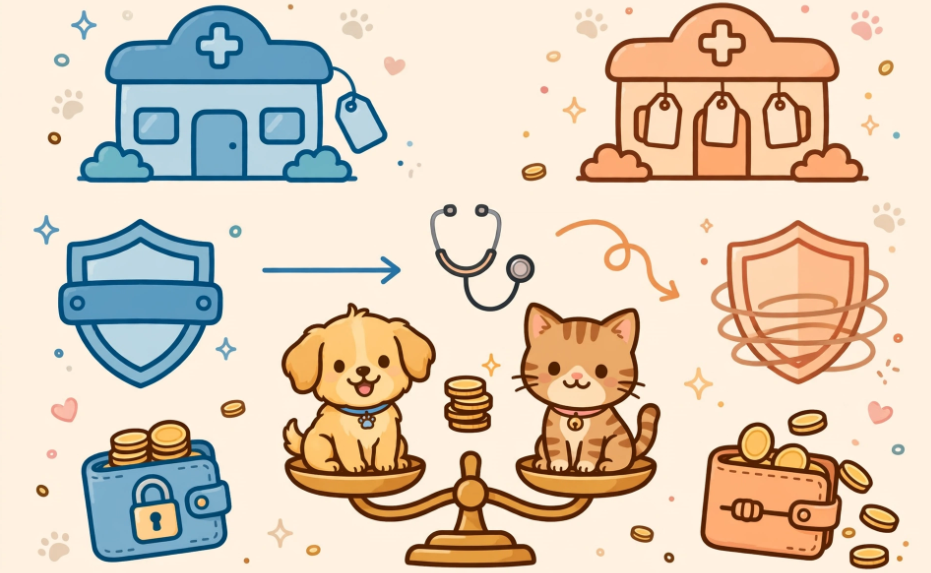
Trupanion locks every policy at a 90% reimbursement rate — there’s no way to trade a lower reimbursement rate for a cheaper premium, or vice versa. Healthy Paws offers a genuine choice: 50%, 60%, 70%, 80%, or 90%, letting you tune your premium up or down depending on how much of each bill you’re comfortable covering yourself. Pets enrolled with Healthy Paws at age 6 or older see this flexibility narrow somewhat, typically limited to a lower reimbursement rate paired with a higher deductible.
Direct Pay: Trupanion’s Real Advantage
This is where Trupanion pulls ahead concretely. As covered in our guide on reimbursement vs. direct pay, Trupanion is the only major insurer running a real-time, software-integrated payment system — VetDirect Pay — that settles its share of the bill directly with participating clinics, often within minutes, rather than reimbursing you afterward. Healthy Paws operates on the standard reimbursement model: you pay in full, then get reimbursed, typically within an average of 24 to 48 business hours according to the company’s own claims data — fast for a reimbursement-model insurer, but still requiring you to front the entire bill first.
For a genuinely large, unplanned bill — a torn ligament repair, an extended hospital stay — that difference is not cosmetic. It’s the difference between needing the full amount in cash at checkout and needing only your deductible and co-insurance share.
Waiting Periods
Trupanion’s waiting periods run 5 days for accidents and 30 days for illness. Healthy Paws’ vary by state but generally run shorter on the illness side, commonly around 15 days, with accident coverage starting immediately in some states and after a short wait in others. Neither gap is large enough to be a deciding factor on its own, but it’s worth checking your specific state’s terms — a topic covered in full in our guide on pet insurance waiting periods.
What You’ll Actually Pay
Healthy Paws is consistently the cheaper of the two, generally running 15-30% below Trupanion for comparable coverage. For context, the North American Pet Health Insurance Association’s most recent State of the Industry report puts the average U.S. accident-and-illness premium across the entire market at $62.44 per month for dogs and $32.21 per month for cats — a useful benchmark against either company’s quote.¹
| Trupanion | Healthy Paws | |
|---|---|---|
| Reimbursement rate | Fixed at 90% | Choose 50%–90% |
| Deductible structure | Per-condition, lifetime ($0–$1,000) | Annual ($100–$1,000) |
| Annual limit | Unlimited | Unlimited |
| Direct vet pay | Yes, real-time (VetDirect Pay) | No — standard reimbursement |
| Wellness add-on | Not offered | Not offered |
| Typical monthly cost | Higher | 15–30% lower on average |
Figures are approximate and change regularly — request a current quote directly from each provider for your specific pet, location, and desired settings before deciding.
Which One Actually Fits Your Situation
Trupanion tends to fit pet owners who specifically want to avoid fronting large bills — the direct-pay network is the standout feature — and owners of pets likely to develop one or two chronic, ongoing conditions rather than a string of unrelated issues, where the lifetime per-condition deductible pays off over years of treatment.

Healthy Paws tends to fit owners who want to control their monthly premium by adjusting the reimbursement rate, and pets more likely to rack up occasional, unrelated claims over time rather than a single long-term condition, where a resetting annual deductible doesn’t create the same repeated cost that a series of new per-condition deductibles could under a different structure.
Neither is a wrong choice — U.S. News rates both among the most reputable providers in the industry, and the decision genuinely comes down to which structural trade-off fits your pet and your budget better.
This article is provided for general informational and educational purposes only and does not constitute insurance advice. Pricing, coverage terms, and features referenced above change over time — always request a current quote directly from each provider before making a decision. Read our full Legal Notice, Privacy Policy, and Cookie Policy for more information.
References
1. North American Pet Health Insurance Association (NAPHIA) — State of the Industry report, average accident-and-illness premium data, 2024/2026.
About the Author
Miguel Ángel Cibeira researches and writes every article on The Vet Bill personally, sourcing information directly from insurance providers, NAPHIA (the North American Pet Health Insurance Association), and other verifiable industry sources. He is not a licensed insurance agent, broker, or carrier — this site offers independent research and general information, not personalized insurance advice. Read the full bio →