Last updated: August 2026 · Reviewed by Miguel Cibeira
This article is for informational and educational purposes only and is not insurance advice. Waiting periods vary by provider, coverage type, and state — always confirm current terms directly with the insurer before enrolling.
Our companion guide, What Is Pet Insurance and How Does It Work?, introduced waiting periods briefly. This article goes deeper: how long they typically last by coverage category, how they differ from pre-existing condition exclusions, and the practical steps that can actually shorten or waive them.
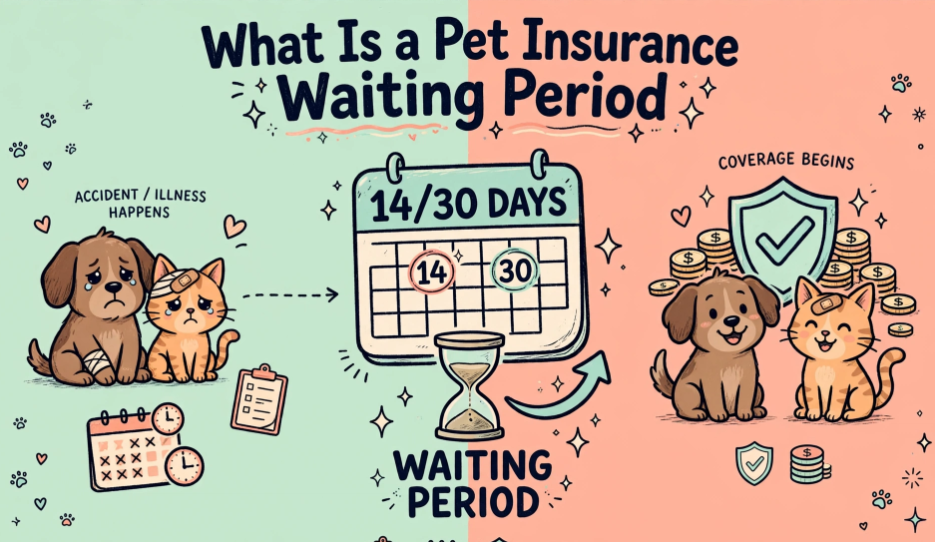
The Basic Definition
A waiting period is the span of time between your policy’s start date and when a specific category of coverage actually becomes active. You’ll pay your premium from day one, but you generally can’t file — or successfully claim on — a covered incident until the relevant waiting period has passed. Insurers use waiting periods specifically to prevent people from enrolling only after their pet is already sick or injured, which would otherwise let anyone buy coverage the moment they already know they need it.
Waiting Periods Are Not the Same as Pre-Existing Condition Exclusions
This distinction trips up a lot of new policyholders, and it’s worth being precise about it. A waiting period is temporary and procedural — once it passes, that category of coverage becomes fully active going forward. A pre-existing condition exclusion, by contrast, is typically permanent: if your pet showed symptoms of a condition before your policy started, or during the waiting period itself, most insurers will treat that specific condition as excluded from coverage indefinitely — even after the waiting period has technically ended and even in future policy years.
In other words, waiting periods and pre-existing conditions interact: if your pet develops symptoms of something during the waiting period, that specific issue can become a permanent exclusion once the waiting period ends, rather than simply becoming covered once the clock runs out. This is exactly why the timing of enrollment matters so much, covered in more detail below.
Typical Waiting Periods by Coverage Category
Waiting periods aren’t uniform — they vary by what type of coverage is involved, generally following this pattern across the industry:
Accidents — Typically the shortest waiting period, commonly 1-3 days, and a small number of insurers (including Embrace, among others) offer zero-day accident coverage, meaning it’s active from the moment your policy starts.
Illnesses — Typically longer than accident coverage, commonly around 14 days across most major providers.
Orthopedic conditions — Often considerably longer, frequently 6 months, reflecting how these conditions (joint issues, hip dysplasia) can develop gradually and be harder to distinguish from a pre-existing issue.
Cruciate ligament injuries specifically — Often carry their own extended waiting period, separate from general orthopedic coverage, also commonly around 6 months in many policies — relevant for owners of larger breeds, which are statistically more prone to this specific injury.
How Waiting Periods Compare Across Providers
Waiting periods differ meaningfully from one insurer to the next, which makes this a genuinely useful point of comparison when choosing a policy — not just the monthly premium. Based on publicly available policy information, here’s how several major providers’ waiting periods have generally compared:
| Provider | Accident | Illness | Orthopedic | Cruciate Ligament |
|---|---|---|---|---|
| ASPCA | 14 days | 14 days | 14 days | 14 days |
| Embrace | 0 days | 14 days | 6 months | 6 months |
| Figo | 1 day | 14 days | 6 months | 6 months |
| Hartville | 14 days | 14 days | 14 days | 14 days |
| Lemonade | 2 days | 14 days | 30 days | 6 months |
Waiting periods change periodically and can vary by state — always confirm current terms directly with the specific insurer before enrolling, rather than relying on a comparison table alone.
The pattern worth noticing: providers differentiate themselves more on accident and orthopedic waiting periods than on illness coverage, where 14 days has become something close to an industry standard.
State Laws Can Shorten Waiting Periods

This is a detail that a surprising number of pet owners don’t realize: waiting periods aren’t purely up to the insurer — some states regulate them directly. In Delaware, Louisiana, Maine, Mississippi, Nebraska, New Hampshire, and Washington, state law prohibits any waiting period for accident coverage entirely, and caps illness and orthopedic waiting periods at 30 days, while also requiring insurers to allow that 30-day period to be waived if the pet completes a veterinary exam paid for by the policyholder. Other states may have their own specific rules. Because these regulations vary and change over time, it’s worth checking with your state’s insurance department or the specific insurer for the rules that actually apply to you, rather than assuming a national average applies everywhere.
How to Shorten or Waive a Waiting Period
You generally can’t eliminate waiting periods entirely, but a few strategies can meaningfully reduce their practical impact:
Get a veterinary exam soon after enrolling. Several providers — including ASPCA, Figo, Trupanion, and others — will waive or shorten certain waiting periods (commonly the orthopedic waiting period specifically) if your pet receives a clean veterinary exam within a set window after enrollment, typically around 30 days. This exam also creates a documented health baseline, which can help avoid disputes later about whether a condition was pre-existing.
Provide proof of continuous prior coverage when switching insurers. If you’re moving from one pet insurance provider to another without a coverage gap, some insurers will honor the waiting periods you already served under your previous policy rather than starting the clock over from zero — though this typically requires documentation showing your prior coverage was continuous and recent.
Check your state’s specific regulations. As covered above, some states legally cap or eliminate certain waiting periods, which can work in your favor without any action needed on your part beyond confirming your state’s rules apply to your specific policy.
Best Practice: Enroll Early
The single most consistently repeated piece of advice across the industry is straightforward: enroll your pet while they’re young and healthy, ideally as soon as you bring a puppy or kitten home. Many providers allow enrollment as early as 6-8 weeks old. The logic is simple — every day that passes before enrollment is a day something could happen that later gets classified as a pre-existing condition, permanently limiting your coverage regardless of how short the waiting period itself turns out to be. This is especially relevant for breeds with well-documented predispositions to specific conditions (like hip dysplasia in larger breeds) — insuring before any symptoms appear is the only way to ensure that specific condition isn’t excluded later as pre-existing.
What to Do If Your Pet Needs Care During the Waiting Period
This is worth stating plainly: don’t delay necessary veterinary treatment simply because you’re still inside a waiting period. Insurance timing shouldn’t factor into an urgent medical decision for your pet. If your pet needs care during the waiting period, that specific visit likely won’t be reimbursed, but seeking care promptly remains the right call for your pet’s health — and, separately, could still matter for documentation purposes if the issue turns out to be unrelated to anything that develops later.
A Nuance Worth Knowing: Curable vs. Non-Curable Pre-Existing Conditions
Some providers distinguish between conditions considered “curable” and those considered permanent when applying pre-existing exclusions — a detail that can meaningfully affect your pet’s future coverage and is worth asking about directly when comparing insurers. A curable condition that fully resolves and shows no recurring symptoms for a defined period (commonly 6-12 months, depending on the insurer) may, with some providers, become eligible for coverage again if it recurs later — while a condition considered chronic or incurable is typically excluded permanently regardless of how much time passes symptom-free. This distinction isn’t universal across every insurer, and the specific waiting period required before a resolved condition is reconsidered varies by provider, so it’s worth confirming a specific insurer’s policy on this directly rather than assuming every company handles a resolved past issue the same way.
Frequently Asked Questions
Can I avoid a pet insurance waiting period entirely? Generally no, though some providers will waive certain waiting periods (often specifically the orthopedic one) with a qualifying veterinary exam, and a handful of states legally require shorter waiting periods or waiver options. A true zero-waiting-period policy across every coverage category is uncommon.
What happens if my pet gets sick during the waiting period? That specific incident typically won’t be covered, and if it results in an ongoing diagnosis, the condition may be treated as pre-existing and excluded from future coverage as well — even after the waiting period ends. This is exactly why enrolling before any symptoms appear matters so much.
Do all insurers use the same waiting periods? No — waiting periods vary meaningfully by provider and by coverage category, as shown in the comparison table above. This is a genuinely useful factor to compare across providers, not just the monthly premium.
Is the illness waiting period always longer than the accident waiting period? Generally yes, across most major providers — accidents are typically covered sooner (sometimes immediately) since they’re by definition sudden, unpredictable events, while illness coverage waiting periods (commonly around 14 days) and orthopedic waiting periods (commonly around 6 months) are longer, reflecting how these conditions can develop more gradually.
Can switching pet insurance companies reset my waiting periods? It can, unless you have documented proof of continuous prior coverage and your new insurer specifically agrees to honor previously served waiting periods. This isn’t guaranteed across all providers, so it’s worth confirming directly with a new insurer before switching, particularly if you’re doing so specifically to seek a lower premium.
Are waiting periods the same in every state? No — some states, including Delaware, Louisiana, Maine, Mississippi, Nebraska, New Hampshire, and Washington, have laws that limit or eliminate certain waiting periods. Always check your specific state’s regulations and the insurer’s current policy terms, since both can change.
This article is provided for general informational and educational purposes only and does not constitute insurance advice. Waiting periods, state regulations, and provider comparisons referenced above are based on publicly available information and are subject to change — always verify current terms directly with the specific insurer and your state’s insurance department before enrolling. Read our full Legal Notice, Privacy Policy, and Cookie Policy for more information.
About the Author
Miguel Ángel Cibeira researches and writes every article on The Vet Bill personally, sourcing information directly from insurance providers, NAPHIA (the North American Pet Health Insurance Association), and other verifiable industry sources. He is not a licensed insurance agent, broker, or carrier — this site offers independent research and general information, not personalized insurance advice. Read the full bio →