Last updated: August 2026 · Reviewed by Miguel Cibeira
This article is for informational and educational purposes only and is not insurance or financial advice. Coverage details and pricing vary by provider, state, and individual policy — always review a specific policy’s terms directly with the insurer before purchasing.
Our companion guide, What Is Pet Insurance and How Does It Work?, introduced the deductible as one of three levers that shape your policy. This article goes deeper: the different deductible structures insurers actually use, how deductible choice interacts with your premium, and how to think about picking the right one for your specific pet.
The Basic Definition
A pet insurance deductible is the amount you’re responsible for paying out of pocket before your insurance starts reimbursing eligible veterinary costs. Deductibles typically range from $0 to $1,000, with most insurers offering set increments — commonly $100, $250, $500, and $1,000 — rather than letting you choose any arbitrary number. Across the industry, $250 is generally cited as the single most commonly chosen deductible amount, striking a middle ground most pet owners find manageable.
Three Deductible Structures — Not Just One

This is where pet insurance deductibles differ meaningfully from what you might expect from other insurance types, and where a lot of confusion comes from. There are actually three distinct structures insurers use, and it’s worth understanding which one a specific policy offers before comparing prices.
Annual deductible. You pay this amount once per policy year, regardless of how many separate claims you file. Once met, every subsequent covered claim that year is reimbursed according to your reimbursement rate, with no additional deductible owed until the policy renews. This has become the dominant structure in the industry — most major insurers, including large providers like MetLife, now offer annual deductibles exclusively rather than the per-incident alternative described below.
Per-incident deductible. You pay this amount separately for each new condition or incident, and — depending on the insurer — it may reset annually alongside your policy renewal. If your dog is treated for an ear infection and later, the same year, injures a leg, you’d pay the deductible twice: once for each unrelated issue.
Lifetime per-condition deductible. A less common but meaningful variant: you pay the deductible once for a specific diagnosed condition, and it’s never charged again for that same condition, even in future policy years — as long as you continue treating that same ongoing issue. This structure is generally more favorable for pets with a single chronic condition requiring years of ongoing management, since you’re not re-paying the deductible annually for the same diagnosis.
Because per-incident deductibles have become considerably less common industry-wide, most comparisons you’ll encounter today are effectively between different annual deductible amounts from different insurers, rather than between deductible structures — but it’s still worth confirming which structure a specific policy uses before assuming.
A Worked Example
Numbers make this concrete faster than definitions alone. Say your policy has a $250 annual deductible and an 80% reimbursement rate.
First vet visit of the year: Your dog needs treatment for a covered illness, and the bill comes to $500. Your insurer subtracts your $250 deductible from the $500 bill, leaving $250. It then applies your 80% reimbursement rate to that remaining $250 — reimbursing you $200, leaving you responsible for a $50 co-pay on top of the $250 deductible you already paid. Total out of pocket: $300 of the $500 bill.
Second vet visit, later that same year: Your dog needs treatment for a different covered issue, and this bill is $700. Because you’ve already met your $250 annual deductible for the year, none of it applies again — your insurer reimburses 80% of the full $700, or $560, leaving you responsible for only the remaining $140.
This is exactly why an annual deductible becomes considerably more valuable the more claims you file within a single policy year — the deductible cost is effectively spread across every claim after the first, rather than being paid fresh each time.
How Deductible Choice Affects Your Premium
Deductible and premium move in opposite directions: a higher deductible generally means a lower monthly premium, since you’re absorbing more of the initial cost yourself, and vice versa. Based on typical industry pricing patterns, moving from a $100 deductible to a $500 deductible with an otherwise identical policy might reduce your monthly premium by roughly $15-35, which adds up to somewhere in the range of $180-420 in annual premium savings — money you keep unless and until you actually file a claim.
That trade-off is genuinely a bet, not a free lunch: choosing the higher deductible saves you money in years with no claims (or claims small enough that the deductible eats the whole cost anyway), but costs you more out of pocket in a year where your pet needs significant treatment.
How to Choose: A Framework, Not a Fixed Answer
There’s no universally “correct” deductible — the right choice depends on your pet’s age and health profile, your reimbursement rate, your annual limit, and your own financial cushion for an unplanned expense. A few commonly cited reference points:
Younger, healthy pets (roughly under 3 years old) tend to file fewer claims in a given year, which is part of why a higher deductible ($500-$1,000) is often suggested for this group — you’re less likely to “use” the lower deductible’s advantage in most years, so the lower monthly premium tends to be the better trade.
Middle-aged pets (roughly 3-7 years old) are often paired with a moderate deductible ($250-$500), balancing manageable monthly costs against a rising likelihood of at least occasional veterinary issues as pets age.
Senior pets (roughly 7+ years old) are more likely to need veterinary care regularly, which is part of why a lower deductible ($100-$250) is often suggested here — if you’re likely to meet the deductible anyway in a given year, a lower one reduces the total amount you pay before reimbursement kicks in.
Breed matters too. Breeds with well-documented higher rates of chronic or hereditary conditions — such as larger breeds prone to joint issues — may be reasonable candidates for a lower deductible even at a younger age, given a higher statistical likelihood of needing care.
These are general starting points, not personalized recommendations — your own financial situation and risk tolerance matter as much as your pet’s profile.
Don’t Evaluate the Deductible in Isolation
This is worth stating directly, because it’s the single most common mistake when comparing policies by deductible alone: the deductible is only one of three interacting levers, alongside your reimbursement rate and annual limit, covered in our companion guide on how pet insurance works. A policy with a $250 deductible, a 70% reimbursement rate, and a $5,000 annual limit can end up costing you more out of pocket over an expensive year than a policy with a $500 deductible, a 90% reimbursement rate, and unlimited annual coverage — even though the second policy’s deductible looks less attractive at first glance. Comparing deductible amounts alone, without factoring in reimbursement rate and annual limit together, can lead to a genuinely misleading conclusion about which policy actually offers better value for your specific situation.
Multi-Pet Households: Per-Pet vs. Family Deductibles
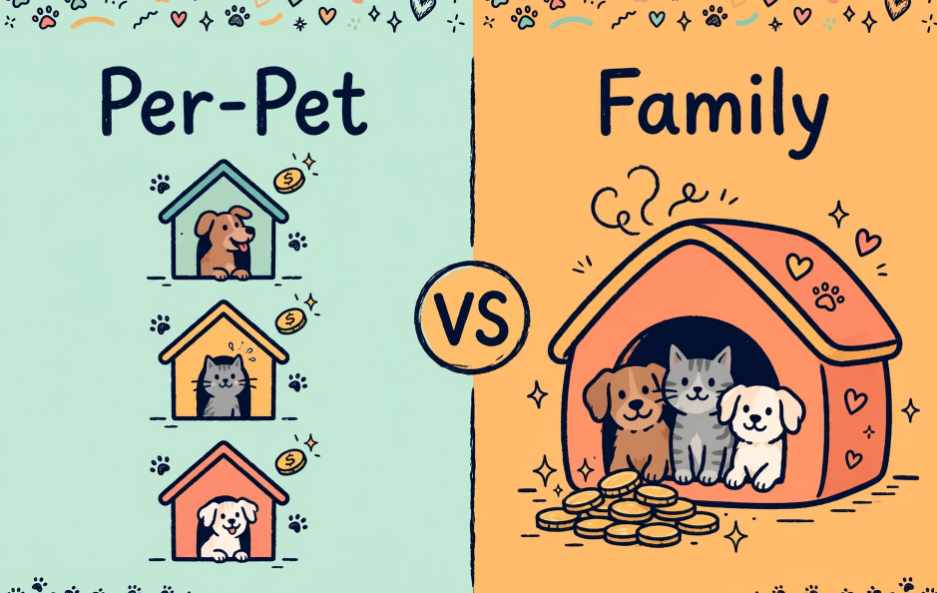
If you’re insuring more than one pet, it’s worth checking whether a provider applies the deductible per pet or offers a combined family deductible. With three dogs each carrying a separate $250 annual deductible, you could face up to $750 in combined deductibles across your household in a bad year — compared to a single $500 family deductible that applies once regardless of which pet is treated. Not all insurers offer a family deductible option, so this is worth confirming directly if you have multiple pets, since it can meaningfully change the real-world cost comparison between providers.
Frequently Asked Questions
What’s the most common pet insurance deductible amount? $250 is generally cited as the most commonly selected deductible across the industry, though options ranging from $100 to $1,000 are widely available, and a small number of insurers offer $0-deductible policies (typically at a considerably higher premium to compensate).
Does a higher deductible mean less coverage? No — your deductible affects your out-of-pocket costs, not what conditions or treatments your policy actually covers. A higher deductible simply means you pay more before reimbursement starts; it doesn’t reduce which conditions are eligible for coverage under your policy’s terms.
Is an annual deductible or a per-incident deductible better? For pet owners who anticipate multiple claims in a given year (such as an older pet or one with an ongoing condition), an annual deductible is generally more favorable, since it’s paid only once regardless of how many separate issues arise. Per-incident deductibles have also become considerably less common industry-wide, so many comparisons today are effectively between annual deductible amounts rather than between the two structures.
Can I change my deductible after enrolling? This varies by insurer — some allow you to adjust your deductible, reimbursement rate, or annual limit at renewal, while others require these choices to remain fixed for the life of the policy, or only allow changes under specific circumstances. Check a specific provider’s policy on mid-term or renewal-time adjustments before assuming you can change it later.
Do I need to meet my deductible before every single vet visit? Not with an annual deductible — once met for the policy year, it doesn’t apply again to subsequent covered claims until renewal. With a per-incident deductible, it’s paid separately for each new, unrelated condition, even within the same policy year.
Should I choose the lowest deductible available to maximize my reimbursement? Not necessarily — the lowest deductible typically comes with the highest monthly premium, and if your pet ends up needing minimal veterinary care in a given year, you may end up paying more in total premiums than you would have paid out of pocket with a higher deductible and lower premium. The right choice depends on your pet’s likely healthcare needs and your own risk tolerance, not simply minimizing the deductible number.
This article is provided for general informational and educational purposes only and does not constitute insurance or financial advice. Deductible amounts, structures, and pricing referenced above are illustrative and vary by provider, state, and individual policy — always verify current details directly with the insurer before purchasing. Read our full Legal Notice, Privacy Policy, and Cookie Policy for more information.
About the Author
Miguel Ángel Cibeira researches and writes every article on The Vet Bill personally, sourcing information directly from insurance providers, NAPHIA (the North American Pet Health Insurance Association), and other verifiable industry sources. He is not a licensed insurance agent, broker, or carrier — this site offers independent research and general information, not personalized insurance advice. Read the full bio →