Last updated: September 2026 · Reviewed by Miguel Cibeira
This article is for informational purposes only and is not insurance advice. Direct pay availability depends on both your insurer and your specific veterinary clinic — always confirm with both before assuming this option applies to you.
Our companion guide on how pet insurance works described the reimbursement model as the industry standard. This article covers the alternative — direct pay — in full detail, including a distinction most comparison articles gloss over: there’s a real difference between a provider that pays your vet at the time of service and one that simply mails your reimbursement check to the vet’s office instead of to you, after the same claims process either way.
The Basic Difference
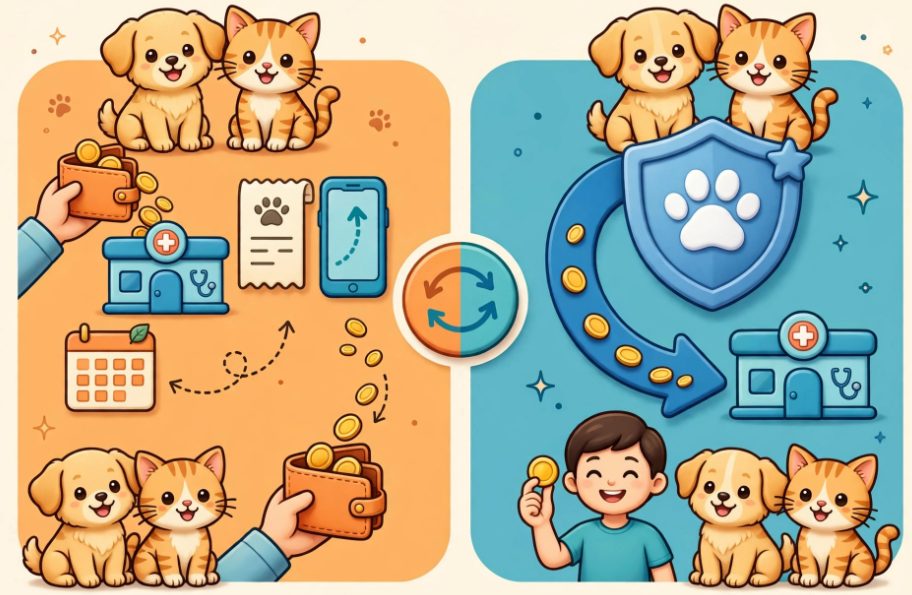
Reimbursement is the default structure across the pet insurance industry — according to industry data from the North American Pet Health Insurance Association (NAPHIA), the large majority of insured pets in the U.S. carry standard accident-and-illness coverage operating this way.¹ You pay your vet bill in full at the time of treatment, submit a claim afterward, and receive reimbursement once it’s processed, a process covered step by step in our guide on how to file a pet insurance claim.
Direct pay flips part of that sequence — in its truest form, your insurer pays the covered portion of the bill directly to your veterinary clinic, meaning you’re only responsible for your own out-of-pocket share (deductible, co-insurance, and any non-covered items) at the time of service, rather than fronting the entire bill yourself and waiting to be reimbursed.
That sounds like a straightforward upgrade, but direct pay is genuinely rare across the industry, and — this is the part worth understanding carefully — not every provider advertising “direct pay” delivers the same thing.
Two Very Different Things Get Called “Direct Pay”
True, real-time direct pay means the insurer pays the clinic at the time of treatment, before you leave the appointment, integrated directly with the clinic’s own billing software. As of 2026, Trupanion is the only major U.S. pet insurer operating this way at meaningful scale, through its proprietary VetDirect Pay system, integrated with more than 11,000 veterinary clinics and hospitals across the U.S. and Canada.² When a participating clinic uses this software, Trupanion’s payment is typically settled within about five minutes at checkout — you pay only your deductible and co-insurance share on the spot, and the clinic receives the rest directly from Trupanion.
Delayed, form-based “direct pay” is what most other providers advertising this feature actually offer, and it works quite differently: you (or your vet) still submit a full claim after treatment, the same as standard reimbursement — but once that claim is processed and approved, the payment is mailed or deposited to the vet’s office instead of to you. Pets Best requires a signed Veterinarian Reimbursement Release form submitted alongside your claim. Healthy Paws requires you to call ahead of your appointment, during business hours, to arrange it, and the vet must agree to accept it. ASPCA lets you indicate this preference on the claim form itself. In every one of these cases, you’re still expected to pay the vet in full at the time of service — the “direct pay” feature only changes where the eventual reimbursement check ends up, not whether you need the cash upfront.
This distinction matters enormously in practice. If you’re facing a large, unexpected bill and specifically need help avoiding an upfront cash crunch, only true, real-time direct pay (currently, in practice, Trupanion) actually solves that problem. The form-based version offered by other insurers is a convenience for settling up with your vet’s office afterward — genuinely useful, but not a solution to the “I don’t have $5,000 sitting in my account right now” problem.
A Real-Dollar Example
This is worth seeing in concrete numbers. Consider a $7,500 emergency surgery — a torn cruciate ligament repair (a TPLO procedure), a genuinely common and expensive claim type. Under a standard reimbursement model, you’d need $7,500 in available cash or credit at the time of treatment, then wait days to weeks for your insurer to send back the covered portion. Under a true real-time direct-pay arrangement, with a $500 deductible and 80% reimbursement rate — the two levers covered in our guide on how the deductible works — you might only need roughly $1,500 out the door at checkout, with the insurer settling the other roughly $6,000 directly with the clinic.
That gap — needing $7,500 in liquid funds on the spot versus needing roughly $1,500 — is precisely the practical problem true direct pay is designed to solve, and it’s a meaningfully different experience than a reimbursement check arriving two weeks later, however welcome that check eventually is.
You Still Owe Your Share, Either Way

Direct pay doesn’t mean free veterinary care — it changes who the insurer pays and when, not how much you’re responsible for. Regardless of payment structure, you still owe your deductible if it hasn’t already been met for the policy year, your co-insurance share (the percentage not covered by your reimbursement rate), any amount above your annual coverage limit, and any non-covered items excluded under your specific policy terms.
The Risk Worth Knowing About
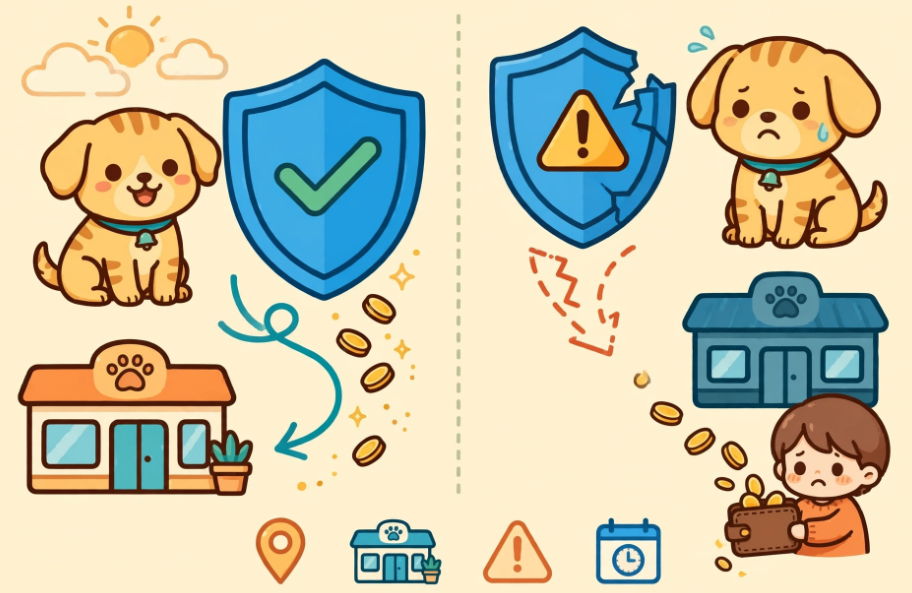
Because direct pay settles the insurer’s portion of the bill before or alongside claim approval in some setups, there’s a specific risk worth understanding: if a claim is later denied — for reasons covered in our guide on filing a claim, such as a condition turning out to be pre-existing, a concept covered in full in what counts as a pre-existing condition — you (and in rarer cases, the clinic) could be on the hook for the full amount the insurer had been expected to cover. This is a meaningfully different risk profile than standard reimbursement, where a denied claim simply means you don’t get money back that you’d already paid out of your own funds.
Not Every Vet Accepts Direct Pay
This is a practical limitation worth confirming before you count on this feature: direct pay, in either its true or form-based version, requires your specific veterinary clinic to participate. For Trupanion’s real-time system specifically, the clinic needs to be running compatible, integrated billing software — meaning even a Trupanion policyholder can’t assume every vet, including specialists or an out-of-town emergency clinic, will support real-time direct pay. For the form-based versions offered by other insurers, the vet’s office simply needs to be willing to accept payment routed to them instead of to you, which most clinics will generally agree to, but it’s still worth confirming rather than assuming.
An Alternative Worth Knowing About: Vet Financing
Separate from pet insurance entirely, some veterinary clinics offer their own point-of-care financing options — services like CareCredit or Scratchpay, and newer buy-now-pay-later options — that let you split a large bill into payments, sometimes at 0% interest for a promotional period, as a bridge while waiting for insurance reimbursement. This isn’t a substitute for insurance coverage itself, but it’s a relevant tool for managing the upfront cash-flow gap that reimbursement-model insurance can create, particularly for pet owners without a true direct-pay option available.
Frequently Asked Questions
Which pet insurance company actually pays the vet in real time?
As of 2026, Trupanion is the only major provider operating a true, software-integrated, real-time direct-pay system at meaningful scale (VetDirect Pay), available at participating clinics. Other providers offering something called “direct pay” typically route your eventual reimbursement check to the vet’s office after standard claims processing, rather than paying at the time of treatment.
Do I still need to pay anything upfront with direct pay?
Yes — you’re still responsible for your deductible, your co-insurance share, and any non-covered costs, even under a true real-time direct-pay arrangement.
What happens if my claim is denied after direct pay has already been arranged?
You could become responsible for the full amount the insurer was expected to cover, since the clinic may need to recover that balance from you if the insurer’s payment doesn’t go through as expected.
Can I request direct pay at any veterinary clinic?
No — the clinic needs to participate, whether that means running compatible billing software (for real-time systems like Trupanion’s) or simply agreeing to accept a redirected reimbursement payment (for form-based versions from other insurers).
Should I choose an insurer based primarily on whether it offers direct pay?
This depends on your own financial cushion for an unexpected large vet bill. If fronting a large bill upfront would be a genuine hardship, true real-time direct pay is a meaningful, practical feature worth prioritizing.
This article is provided for general informational and educational purposes only and does not constitute insurance advice. Direct pay availability, mechanics, and participating providers referenced above are current as of the “last updated” date and are subject to change — always confirm current direct-pay options directly with the insurer and your specific veterinary clinic before relying on this feature. Read our full Legal Notice, Privacy Policy, and Cookie Policy for more information.
References
1. North American Pet Health Insurance Association (NAPHIA) — State of the Industry report data on accident-and-illness policy prevalence, 2026.
2. Trupanion — VetDirect Pay program details, including participating clinic network size, per Trupanion’s public investor and press materials, 2026.
About the Author
Miguel Ángel Cibeira researches and writes every article on The Vet Bill personally, sourcing information directly from insurance providers, NAPHIA (the North American Pet Health Insurance Association), and other verifiable industry sources. He is not a licensed insurance agent, broker, or carrier — this site offers independent research and general information, not personalized insurance advice. Read the full bio →