Last updated: August 2026 · Reviewed by Miguel Cibeira
This article is for informational and educational purposes only and is not insurance advice. Pricing and coverage details vary by provider, pet, location, and individual policy — always request a specific quote before deciding.
Our companion guide, What Is Pet Insurance and How Does It Work?, mentioned that pet insurance comes in different plan types. This article breaks down the two most common: accident-only and accident-and-illness coverage — what each actually protects against, what the real price gap looks like once you control for identical policy settings, and the narrow set of circumstances where the cheaper option genuinely makes sense.
The Basic Difference
Accident-only coverage reimburses you for injuries resulting from unexpected external events — broken bones, lacerations, bite wounds, burns, foreign object ingestion, poisoning, and trauma from incidents like being hit by a car. It does not cover illnesses of any kind.
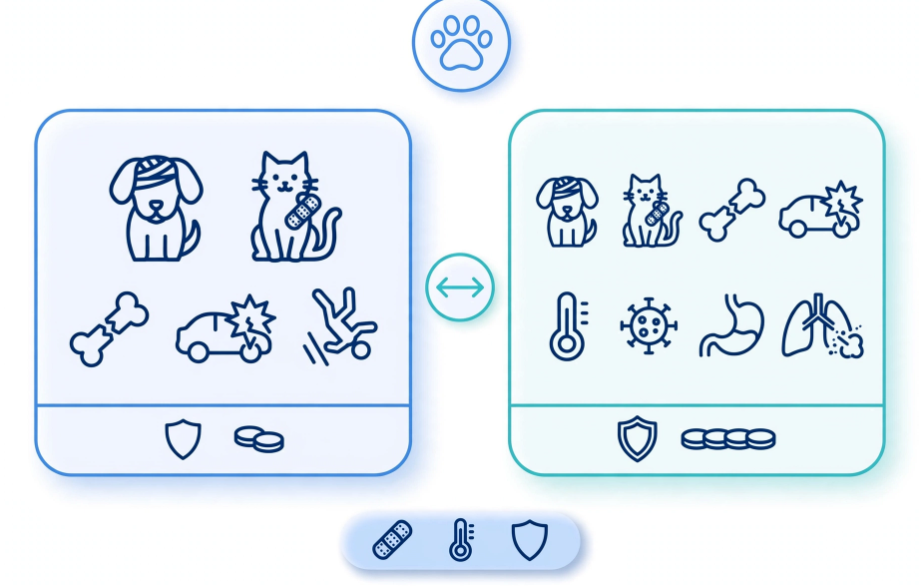
Accident-and-illness coverage includes everything accident-only coverage does, plus illnesses: infections, cancer, chronic and hereditary conditions (like diabetes, arthritis, or heart disease), allergies, gastrointestinal issues, and other health conditions not caused by a specific accidental event.
The distinction matters more than it might first appear, because illness-related claims — not accidents — generate the majority of the largest, most expensive veterinary bills pet owners actually face.
What Accident-Only Plans Leave Out
It’s worth being concrete about what falls outside accident-only coverage, since the gap is larger than the name might suggest. Common conditions not covered under an accident-only plan include: parvovirus and other infections, respiratory infections, ear infections, skin conditions and allergies, hereditary and congenital disorders, cancer, diabetes, arthritis, heart disease, and glaucoma — essentially any health issue that isn’t the direct result of a specific accidental injury.
The Real Price Difference
Based on North American Pet Health Insurance Association (NAPHIA) industry data, national average monthly premiums have recently run around $16.10 for accident-only dog coverage versus roughly $43 for accident-and-illness dog coverage, and around $9.17 versus $23 for cats — accident-only running as much as 70%+ cheaper at the level of national averages.
But that headline gap can be misleading, and it’s worth understanding why. National averages blend policies with very different deductibles, reimbursement rates, and annual limits across the entire market. When you compare accident-only and accident-and-illness quotes from the same provider, with identical deductible, reimbursement rate, and annual limit settings, the real-world gap is often considerably smaller than the national averages suggest — sometimes as little as $7-30 per month, rather than the $25-45 gap the blended averages imply. Some providers’ base accident-and-illness plans are priced close enough to their own accident-only option that the “budget choice” isn’t nearly as clear-cut as the industry-wide averages make it look.
The practical takeaway: don’t decide based on published national averages alone. Request an accident-only quote and an accident-and-illness quote from the same provider, with the same deductible and reimbursement settings, for your actual pet — the real gap you’re being asked to pay for illness coverage may be much smaller than you’d assume.

The Break-Even Math
This is the calculation that matters most when deciding between the two, and it’s worth working through directly. Suppose the real-world price difference between accident-only and accident-and-illness coverage for your pet comes out to roughly $84 per year (about $7 per month) — a gap cited in some direct provider comparisons for a young, mixed-breed dog with a mid-range deductible.
That $84 annual difference buys you coverage for conditions that can individually cost far more than the premium gap itself: a cancer diagnosis, for example, commonly runs somewhere in the $5,000-$12,000 range depending on the type and treatment path. According to veterinary industry data, roughly 1 in 3 pets develop a significant illness in any given year. If your pet develops even one meaningful illness over the life of the policy — something outside the narrow accident-only definition — the relatively small annual premium difference for illness coverage can pay for itself many times over from that single claim.
This math shifts, of course, if the real price gap for your specific pet, breed, and location is considerably larger than $84 a year — which is exactly why getting an actual quote matters more than relying on a general average.
When Accident-Only Might Still Make Sense
Despite the math above generally favoring accident-and-illness coverage, there are narrower circumstances where accident-only coverage is a defensible choice:
A very tight, fixed budget where any coverage is better than none. If accident-and-illness coverage simply isn’t affordable, accident-only coverage still protects against sudden, often expensive emergencies (like a car accident or a foreign object ingestion requiring surgery) that could otherwise be a significant unplanned cost.
A senior pet aging out of full coverage with some providers. Some insurers cap the age at which a pet can newly enroll in accident-and-illness coverage, while continuing to offer accident-only coverage without an upper age limit — making accident-only one of the few options remaining for insuring an older pet for the first time.
A pet with a known, already-excluded chronic condition where illness coverage would largely go unused. If your pet already has a documented pre-existing condition that would be excluded regardless of plan type, and that condition represents your primary health concern, the incremental value of illness coverage for other, still-unknown future conditions is a more genuinely personal calculation.
If you fall into one of these situations, it’s still worth checking the annual limit carefully — some low-cost accident-only plans cap total annual reimbursement at a relatively low figure (in some cases as low as $2,500), which a single serious emergency surgery can exceed on its own. A slightly higher-priced accident-only plan with a meaningfully higher annual limit is often a better value than the cheapest option available.
A Practical Comparison Checklist
Before choosing between the two plan types, it’s worth confirming:
- The actual quoted price gap for your specific pet from the same provider, at identical deductible and reimbursement settings — not a national average
- The annual limit on any accident-only plan you’re considering, to make sure a single serious emergency wouldn’t exceed it
- Whether the provider you’re considering even offers a standalone accident-only option — some major insurers only sell accident-and-illness coverage, with no separate accident-only tier
- Your pet’s breed-specific risk profile — breeds prone to hereditary or chronic conditions tilt the math further toward accident-and-illness coverage, since those are exactly the categories accident-only excludes
A Range of Real-World Pricing Examples
To illustrate how much variation exists beneath the national averages, consider the spread across different providers for otherwise comparable coverage. Accident-only plans have been quoted as low as roughly $9-18 per month for cats and $15-25 per month for dogs across different insurers, while accident-and-illness plans for a similar profile have ranged more broadly — some entry-level accident-and-illness policies have been priced close to $10-12 per month for young, low-risk pets, not far above the accident-only tier at all, while more comprehensive accident-and-illness plans with higher limits and reimbursement rates can run considerably higher.
This spread reinforces the core point of this article: the gap between the two plan types isn’t fixed, and it depends heavily on the specific provider, your pet’s age and breed, your location, and the deductible and reimbursement settings you choose. A young, low-risk pet at a competitively priced insurer might see barely any premium difference between accident-only and accident-and-illness coverage — in which case there’s little reason to choose the more limited option at all — while an older or higher-risk pet at a different provider might see a much wider gap, making the trade-off a more genuine budget decision.
Frequently Asked Questions
Is accident-only pet insurance worth it? It depends heavily on the actual price gap for your specific pet and provider, not the national averages alone. Given that illness-related claims tend to generate the largest, most expensive vet bills, and that the real-world price gap between the two plan types is often smaller than headline averages suggest, accident-and-illness coverage is generally the more protective choice for most pet owners — but accident-only remains a reasonable option in narrower circumstances, such as a tight budget or an older pet with limited enrollment options.
Does accident-only insurance cover illnesses caused by an accident? Generally no — accident-only policies typically exclude the treatment of illnesses even when they arise as a complication of a covered accident, though the exact treatment of complications can vary by provider and policy, so it’s worth confirming this specific detail before assuming coverage extends to secondary complications.
Why is the price gap between accident-only and accident-and-illness sometimes smaller than expected? Published national averages blend a wide range of deductibles, reimbursement rates, and annual limits across the entire market, which can overstate the real gap for any specific policy configuration. When comparing identical settings from the same provider, the actual difference is often considerably smaller than the blended averages suggest.
Can I upgrade from accident-only to accident-and-illness coverage later? This depends on the provider, but even where it’s allowed, any illness or condition your pet has already developed by the time you upgrade would likely be treated as pre-existing and excluded going forward — the same logic covered in our companion guide on waiting periods. Upgrading early, before any health issues develop, avoids this problem entirely.
Do all pet insurance companies offer both accident-only and accident-and-illness plans? No — some major insurers, including at least one large provider known for a fast digital claims process, only offer accident-and-illness coverage with no standalone accident-only tier. It’s worth checking which plan types a specific provider actually offers before assuming both are available.
What’s the single biggest risk of choosing accident-only coverage? That your pet develops a significant, expensive illness — cancer, a chronic condition, a serious infection — that falls entirely outside accident-only coverage, at a cost that can easily exceed years’ worth of the premium savings the accident-only plan provided.
This article is provided for general informational and educational purposes only and does not constitute insurance advice. Pricing figures referenced above are based on industry-wide averages and third-party comparisons and will not reflect your actual quote — request a specific quote for your pet from the provider directly before making a decision. Read our full Legal Notice, Privacy Policy, and Cookie Policy for more information.
About the Author
Miguel Ángel Cibeira researches and writes every article on The Vet Bill personally, sourcing information directly from insurance providers, NAPHIA (the North American Pet Health Insurance Association), and other verifiable industry sources. He is not a licensed insurance agent, broker, or carrier — this site offers independent research and general information, not personalized insurance advice. Read the full bio →