Last updated: August 2026 · Reviewed by Miguel Cibeira
This article is for informational and educational purposes only and is not insurance or veterinary advice. Enrollment ages, coverage terms, and pricing vary by provider — always confirm current details directly with the insurer.
Our companion guides on waiting periods and how pet insurance works both point to the same underlying advice: enroll early. This article focuses specifically on puppies — the actual minimum enrollment age, why “young and healthy” is a riskier assumption than it sounds, and the timeline that gives a new puppy the broadest possible protection.
The Short Answer
Most pet insurance providers accept puppies as young as 6-8 weeks old, and the general consensus across the industry is that this early window — as soon as your puppy is eligible — is the best time to enroll, not a “someday” decision to revisit later. The reasoning comes down to a single mechanism covered throughout this site: pet insurance doesn’t cover pre-existing conditions, and a puppy enrolled before any health issue develops has, by definition, no pre-existing conditions yet.
Why “Young and Healthy” Is a Bit of a Myth
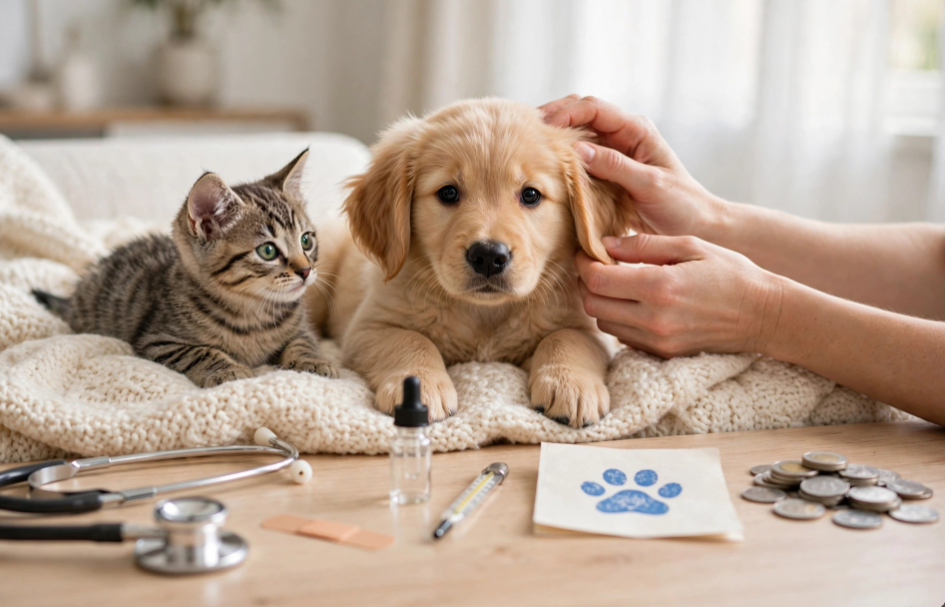
This is worth addressing directly, because it’s the assumption that leads many pet owners to delay enrollment. Puppies aren’t actually low-risk simply because they’re young — in some respects, they carry more accident risk than adult dogs, for two specific reasons: their immune systems are still developing, and their behavior is, almost by definition, more reckless and exploratory.
Puppies chew on things adult dogs generally leave alone — electrical cords, toys, socks, toxic houseplants, and human food that can be dangerous to dogs. That curiosity translates directly into real veterinary costs: intestinal blockage surgery from a swallowed foreign object can run up to roughly $7,000, poisoning treatment can reach roughly $5,000, and injuries like broken bones, electrical cord shock, or lacerations commonly run $2,500-$3,000 or more. None of these are exotic scenarios — insurers specifically flag them as some of the most common puppy claims they process.
On the illness side, young, developing immune systems make puppies more susceptible to certain infections and conditions — parvovirus, ear infections, urinary tract infections, and, less commonly but seriously, conditions like meningitis. These aren’t primarily “old dog” problems; several are specifically more common in a puppy’s first year or two.
Breed-Specific Conditions Worth Insuring Against Early
Beyond general accident and illness risk, many hereditary and congenital conditions are breed-predictable, even though they don’t always show symptoms until later in a dog’s life. Common examples include hip dysplasia and certain heart conditions in dogs generally, epilepsy in breeds like beagles, and eye problems that can appear breed-wide across several popular dog breeds. If you know your puppy’s breed carries an elevated risk for a specific condition, enrolling before that condition could plausibly develop is the only way to ensure it isn’t later excluded as pre-existing — waiting until symptoms actually appear defeats the purpose entirely, since by then it’s too late for insurance to help with that specific condition.
The Premium Argument: Why Earlier Also Tends to Be Cheaper
Pet insurance premiums generally rise with a pet’s age, reflecting the higher likelihood of veterinary care as pets get older. Enrolling a puppy means starting at the lowest point on that pricing curve for your specific pet — you’ll still see your own premium increase over your dog’s lifetime as they age, the same as any pet insured at any starting age, but you avoid the alternative of enrolling later at an already-elevated age-based rate, on top of whatever pre-existing exclusions may have accumulated by then. Enrolling early isn’t about permanently “locking in” a fixed rate for life — it’s about starting the age-based pricing curve from its lowest point rather than a later, higher one.
The Other Side: There’s a Point Where It Becomes Too Late
This deserves equal attention: waiting too long doesn’t just mean accumulating potential pre-existing exclusions — it can eventually mean losing the ability to enroll at all. Many pet insurance providers cap the age at which a pet can be newly enrolled, commonly somewhere in the 7-to-14-year range depending on the insurer. This is specifically why the common assumption — “I’ll wait until my dog is a bit older and I know more about their health” — can backfire: the “waiting” period itself is exactly when a condition is most likely to develop and become a permanent exclusion, and if you wait long enough, some providers may decline new enrollment altogether.
A Warning: Don’t Drop Coverage Once the “Puppy Risks” Pass
This is a genuinely underappreciated point worth stating directly. Some pet owners consider canceling their policy once their dog grows out of the classic puppy hazards — the cord-chewing, the sock-swallowing — reasoning that the highest-risk period has passed. Industry perspective generally pushes back on this: as pets age, the type of risk shifts rather than disappears. A puppy is more likely to eat something they shouldn’t; an adolescent or adult dog is more likely to tear a knee ligament during active play; an older dog faces rising cancer and chronic disease risk. If you cancel coverage and later decide to re-enroll — with the same or a different insurer — any condition that developed or was diagnosed during the coverage gap would likely be treated as pre-existing under the new policy, potentially permanently excluding coverage you’d already been paying for previously. Maintaining continuous coverage, rather than treating it as a puppy-specific purchase, is generally the more protective approach across your pet’s full lifetime.
A Practical Enrollment Timeline
The day you bring your puppy home (or as close to it as possible): Check your preferred insurer’s minimum enrollment age — commonly 6-8 weeks — and start comparing plans.
Before or shortly after enrolling: Schedule a veterinary wellness exam. As covered in our companion guide on waiting periods, a documented clean bill of health early on can help some insurers waive or shorten certain waiting periods, and it establishes a clear health baseline that can help avoid disputes later about whether a condition was pre-existing.
At enrollment: Decide between accident-only and accident-and-illness coverage — covered in more depth in our companion comparison guide — keeping in mind that illness-related claims, not just accidents, are common even in young puppies.
After enrollment: Understand your specific waiting periods by coverage category before assuming you’re fully covered, since accident coverage often activates faster than illness or orthopedic coverage.
Ongoing: Maintain continuous coverage as your dog ages, rather than treating pet insurance as something you might “graduate out of” once the puppy stage passes.
A Seasonal Wrinkle Worth Knowing
One detail that’s easy to overlook: a puppy that’s genuinely healthy the day you bring them home can still develop a condition shortly afterward that has nothing to do with age or breed — seasonal allergies being a common example. A puppy adopted in the fall, for instance, might show no signs of allergies until their first spring, when seasonal triggers appear for the first time. This is really just a specific illustration of the broader pre-existing-condition logic covered throughout this site: the earlier your policy is active and past its waiting period, the more of your puppy’s actual future health history — including conditions that wouldn’t have been predictable at enrollment — falls under coverage rather than being excluded because it emerged just before you got around to signing up.
Frequently Asked Questions
What is the youngest age I can get pet insurance for a puppy? Most providers accept puppies starting at 6-8 weeks old, though this varies slightly by insurer — check the specific minimum age for any provider you’re considering.
Is it really worth insuring a puppy that seems perfectly healthy? Based on industry claims data, yes, in the sense that puppies face real, common risks — both accidental (foreign object ingestion, injuries from their own curiosity) and illness-related (infections, immune-system-related conditions) — that aren’t obvious from a puppy’s outward appearance of health at the time of enrollment.
Does enrolling my puppy early permanently lock in a low price? Not exactly — your premium will still increase over your pet’s lifetime as they age, the same as any insured pet. What early enrollment does is start that pricing curve from its lowest point and avoid pre-existing condition exclusions that could otherwise accumulate while you wait.
Should I get accident-only or accident-and-illness coverage for a puppy? This is covered in more depth in our companion comparison guide, but it’s worth noting that puppies face meaningful illness risk (infections, immune-related conditions), not just accident risk, which is a relevant factor when weighing the two plan types for a young pet specifically.
Is there an age limit for enrolling an older dog if I missed the puppy window? Many insurers cap new enrollment somewhere in the 7-to-14-year age range, though this varies by provider, and some insurers have no upper age limit at all. It’s not necessarily too late for an older dog, but the range of available options, pricing, and coverage terms may be more limited than enrolling earlier would have been.
Should I cancel my pet’s insurance once they’re past the typical “puppy accident” stage? Most guidance from within the industry advises against this — health risks evolve rather than disappear as pets age (from accidental injuries in puppyhood toward orthopedic issues and chronic disease later in life), and canceling coverage creates a gap that could turn any newly developed condition into a permanent pre-existing exclusion if you try to re-enroll later.
This article is provided for general informational and educational purposes only and does not constitute insurance or veterinary advice. Enrollment ages, coverage terms, and cost figures referenced above vary by provider and are subject to change — always verify current details directly with the specific insurer and consult your veterinarian with questions about your puppy’s individual health needs. Read our full Legal Notice, Privacy Policy, and Cookie Policy for more information.
About the Author
Miguel Ángel Cibeira researches and writes every article on The Vet Bill personally, sourcing information directly from insurance providers, NAPHIA (the North American Pet Health Insurance Association), and other verifiable industry sources. He is not a licensed insurance agent, broker, or carrier — this site offers independent research and general information, not personalized insurance advice. Read the full bio →